DRACUNCULIASIS - CHAD: REEMERGENCE, 2010
****************************************
A ProMED-mail post
<
http://www.promedmail.org>
ProMED-mail is a program of the
International Society for Infectious Diseases
<
http://www.isid.org>
Date: Fri 10 Jun 2011
Source: CDC. MMWR Morb Mortal Wkly Rep 2011; 60(22): 744-8 [edited]
<
http://www.cdc.gov/mmwr/pdf/wk/mm6022.pdf>
Infections with Guinea worm emerged in Chad in 2010
---------------------------------------------------
Transmission of dracunculiasis (Guinea worm disease), a waterborne,
parasitic disease targeted for eradication, was thought to have been
interrupted in Chad since 2000, when the last case was reported.
However, in 2010, 10 cases were confirmed by the Chad Ministry of
Public Health (Ministere de la Sante Publique [MSP]) and the World
Health Organization (WHO) during field investigations in which rumored
cases were investigated and nearby villages were actively searched for
additional cases. Because patients were not prevented from
contaminating water sources, new cases were expected in 2011. During
January-February 2011, MSP, WHO, and CDC conducted an investigation to
gather additional information to guide prevention and response
activities before the 2011 transmission season. 7 districts where
cases had been confirmed or suspected in 2010 or where dracunculiasis
was endemic during 1994-2000 were surveyed. The results of those
surveys indicated that residents of 116 (55 percent) of 210 villages
and 13 (87 percent) of 15 nomad camps consumed water from unsafe
sources; 157 (75 percent) of 209 village key informants (KIs) and 5
(33 percent) of 15 nomad camp KIs knew about dracunculiasis. 31
villages had confirmed or suspected cases during 2009-2011 and were
classified as at-risk, requiring weekly active surveillance and urgent
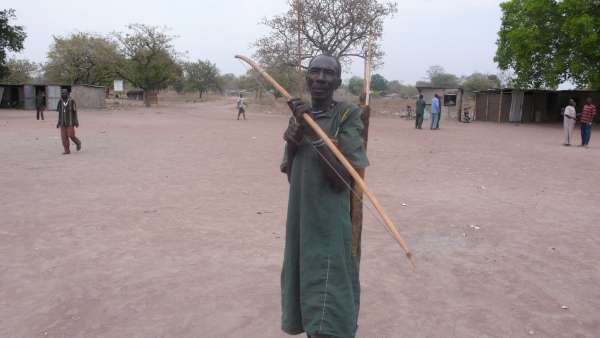
pre-positioning of materials for the 2011 transmission season. Nomadic
populations are at risk for dracunculiasis because of unsafe water
consumption and minimal knowledge of the disease. These populations
also require targeted surveillance and prevention efforts (such as,
filter distribution, education, and case containment*) to interrupt
dracunculiasis transmission (1).
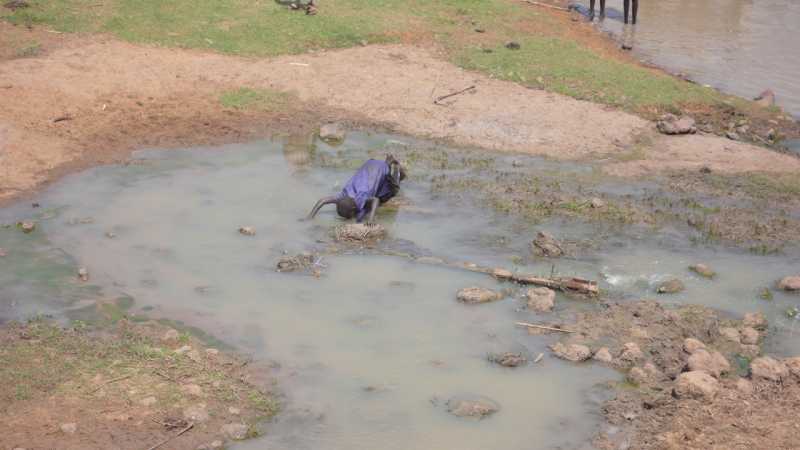
Dracunculiasis is transmitted by drinking unsafe** stagnant water
contaminated by copepods (water fleas) that contain _Dracunculus
medinensis_ larvae. The copepods are digested in the human
gastrointestinal tract and release the larvae, which penetrate the gut
wall. The larvae mate, and pregnant female worms mature in connective
tissues, growing to 2-3 feet (70-100 centimeters) in length.
Approximately 10-14 months after initial ingestion, the female Guinea
worm creates a painful burning blister on the patient's skin. When
this lesion is bathed in water to ease the symptoms, the worm emerges
and ejects larvae into the water, which are ingested by copepods,
starting the cycle anew.
To manage the illness, the emerging worm is removed by rolling it
around gauze or a stick a few centimeters per day; extraction is
painful and can take weeks. Antibiotic ointment may be applied to the
lesion to prevent secondary bacterial infections that can result in
cellulitis, septic arthritis, joint contractures, and permanent
disability. Currently, no effective drug to treat or vaccine to
prevent dracunculiasis is available, and persons who contract
dracunculiasis do not become immune (2,3). Dracunculiasis can be
prevented by 1) educating patients with emerging worms to avoid
bathing affected body parts in drinking water sources, 2) filtering
potentially contaminated drinking water through cloth or pipe filters,
3) treating potentially contaminated stagnant drinking water with a
larvicide such as temephos (such as, Abate), 4) providing safe
drinking water, and 5) detecting cases before the worm emerges to
prevent patients with emerging worms from contaminating water supplies
(4).
During April-June 2010, 2 rumored dracunculiasis cases were reported
to Chad's National Guinea Worm Eradication Program (NGWEP). Cases were
confirmed upon investigation, and extracted worms were further
verified as _D. medinensis_ at CDC by polymerase chain reaction (PCR)
testing (5). Subsequently, NGWEP initiated an outbreak response with
the assistance of WHO, which used house-to-house surveys to search for
cases in all villages with confirmed, suspected, or rumored 2010 cases
and in villages visited by patients during the 10-14 month incubation
period preceding worm emergence. A rumored case was defined as an
alleged dracunculiasis case based on any information obtained from any
source (6); a suspected case was defined as a rumored case
investigated by MSP or the investigation team with a history, reported
by the patient or family, consistent with dracunculiasis but without
an observed worm; a confirmed case was defined as any case with a
history, reported by the patient or family, consistent with
dracunculiasis and with a worm observed by MSP or the investigation
team. KIs in neighboring villages also were interviewed. Additional
house-to-house surveys later were conducted as part of poliomyelitis
vaccination campaigns.
By October 2010, surveys, awareness campaigns, and increased
surveillance had uncovered 8 additional cases, all confirmed by worm
collection (3 cases were further verified by PCR testing at CDC). The
10 confirmed cases were located in 8 different villages in 5
districts, within 4 regions of Chad [see Figure at source URL above].
6 of the 8 villages border the Chari River. Because of late detection,
none of the 10 patients were prevented from contaminating drinking
water sources; therefore, continued transmission was expected during
the 2011 dracunculiasis transmission season, typically the
April-October rainy season in Chad, when many villages are not
accessible by road from the capital.
On 22 Dec 2010, MSP and WHO requested CDC assistance in conducting a
dracunculiasis outbreak investigation. Objectives included 1)
conducting active searches among sedentary and nomadic populations, 2)
identifying ways to strengthen dracunculiasis surveillance, 3)
evaluating general dracunculiasis knowledge, 4) sensitizing and
educating persons about dracunculiasis, and 5) identifying at-risk
localities in which to pre-position prevention and treatment supplies
for the 2011 transmission season.
A total of 210 villages in 7 districts were surveyed [see Table at
source URL above]; 138 (66 percent) had a safe water source, but
residents of 116 (55 percent) villages consumed unsafe water
(including residents in some villages with a safe water source). Among
village KIs, 75 percent were aware of dracunculiasis, 55 percent knew
how to prevent the disease, 59 percent knew how it is transmitted, 63
percent had seen someone with dracunculiasis, and 6 percent had seen
someone with dracunculiasis during 2007-2011. Only 21 percent had
heard about the monetary reward system for reporting a dracunculiasis
case [see Table at source URL above]. In 10 (5 percent) villages, at
least one villager among those assembled reported that one or more
rumored cases were seen during 2007-2011. 20 rumored cases were
reported in these 10 villages and subsequently were investigated. Of
these 20 rumored cases, 7 were found to have a history consistent with
dracunculiasis and were classified as suspected cases.
A total of 15 nomad camps in 5 districts were visited [see Table at
source URL above]. 87 percent of nomad KIs reported camp residents
consumed unsafe water sometime during the year. These populations
interact regularly with sedentary populations, either to share water
sources or to attend weekly markets. No nomad KI had seen a case
during 2007-2011 or knew about the monetary reward system.
Since the investigation, the 1st 2 2011 cases were confirmed in Chad.
The 2 cases increased the total number of at-risk villages to 36,
including the 2 patients' villages of residence and 3 additional
villages visited by one of the patients during the 10-14 months
preceding worm emergence (7).
[Reported by: Mathias R. Djidina, MD, Div of Communicable and
Non-Communicable Disease Prevention; Hassan Guialoungou, Baba Brahim
Dono, Neloumta Ngarhor, Miyara Padjaina, Chad National Guinea Worm
Eradication Program, Chad Ministry of Public Health. Gautam Biswas,
MD, Dieudonne Sankara, MD, Alouseini Maiga, MD, Honore Djimrassengar,
MD, World Health Organization. WHO Collaborating Center for Research
Training and Eradication of Dracunculiasis, Div of Parasitic Diseases
and Malaria, Center for Global Health; Sharon L. Roy, MD, Div of
Foodborne, Waterborne, and Environmental Diseases, National Center for
Emerging and Zoonotic Infectious Diseases; Charbel El Bcheraoui, PhD,
Jenny A Walldorf, MD, EIS officers, CDC. Corresponding contributor:
Jenny A. Walldorf, CDC, <
jwalldorf@cdc.gov>]
Notes
-----
* A dracunculiasis case is contained if all of the following
conditions are met: 1) the patient is detected within 24 hours of worm
emergence; 2) the patient has not entered any water source since worm
emergence; 3) the village health worker has properly managed the case
by cleaning and bandaging until the worm is fully removed and by
giving health education to discourage the patient from contaminating
any water source; and 4) the containment process, including
verification of diagnosis, is validated by a supervisor within 7 days
of worm emergence.
** Unsafe stagnant water sources included ponds, pools in drying
riverbeds, and shallow, uncovered wells. Safe water sources were those
protected from possible Guinea worm contamination, including flowing
rivers, covered hand-dug wells, or borehole wells.
References
----------
1. World Health Organization. Dracunculiasis eradication: case
definition, surveillance and performance indicators. Wkly Epidemiol
Rec 2003; 37: 323-8 [available at
<
https://www.who.int/wer/2003/en/wer7837.pdf>].
2. Imtiaz R, Hopkins DR, Ruiz-Tiben E: Permanent disability from
dracunculiasis. Lancet 1990; (8715): 630.
3. Ruiz-Tiben E, Hopkins DR: Dracunculiasis. In: Guerrant RL, Walker
DH, Weller PF, eds. Tropical infectious diseases: principles,
pathogens, and practice. 2nd ed. New York, NY: Elsevier; 2006:
1204-7.
4. Ruiz-Tiben E, Hopkins DR: Dracunculiasis (Guinea worm disease)
eradication. Adv Parasitol 2006; 61:275-309 [abstract available at
<
http://www.ncbi.nlm.nih.gov/pubmed/16735167>].
5. Bimi L, Freeman AR, Eberhard ML, Ruiz-Tiben E, Pieniazek NJ:
Differentiating _Dracunculus medinensis_ from _D. insignis_, by the
sequence analysis of the 18S rRNA gene. Ann Trop Med Parasitol 2005;
99(5): 511-7 [available at
<
http://www.cartercenter.org/documents/2147.pdf>].
6. World Health Organization Collaborating Center for Research,
Training and Eradication of Dracunculiasis. Guinea worm wrap-up no
203. Atlanta, GA: US Department of Health and Human Services, CDC;
2011. Available at
<
http://cartercenter.org/resources/pdfs/ ... up/203.pdf>.
Accessed 6 Jun 2011.
7. World Health Organization Collaborating Center for Research,
Training and Eradication of Dracunculiasis. Guinea worm wrap-up no
204. Atlanta, GA: US Department of Health and Human Services, CDC;
2011. Available at
<
http://cartercenter.org/resources/pdfs/ ... up/204.pdf>.
Accessed 6 Jun 2011.
--
Communicated by:
ProMED-mail
<
promed@promedmail.org>
[The full report including tables, map, and editorial comments can be
found at <
http://www.cdc.gov/mmwr/pdf/wk/mm6022.pdf>.
The latest WHO report from 2008 on the guinea worm eradication
program can be found at
<
http://whqlibdoc.who.int/hq/2008/WHO_HT ... .1_eng.pdf>,
and an update at <
http://www.who.int/dracunculiasis/en/>.
The HealthMap/ProMED-mail interactive map of Chad can be seen at
<
http://healthmap.org/r/0YDB> - Mod.EP]