

****************************************************
A ProMED-mail post
<http://www.promedmail.org>
ProMED-mail is a program of the
International Society for Infectious Diseases
<http://www.isid.org>
Date: Wed 19 Aug 2009
Source: The New Vision [edited]
<http://www.newvision.co.ug/D/8/12/691810>
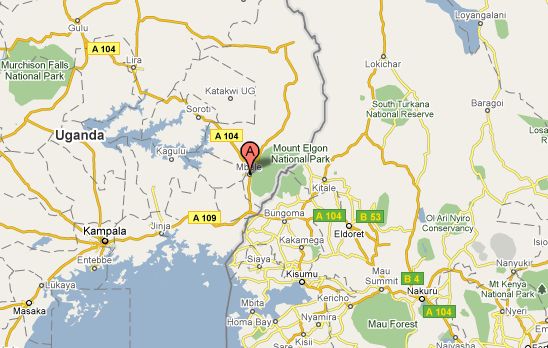
Ebola haemorrhagic fever suspect in Mbale, Uganda
-------------------------------------------------
Medical workers in Mbale Hospital have been put on high alert
following the admission of a patient suspected to have Ebola
haemorrhagic fever. The suspect was referred to Mbale from Tororo
Hospital at 11:00 am on Tuesday [18 Aug 2009] after his condition
deteriorated. A senior nursing officer in Mbale Hospital said
precautionary measures had been taken. The patient has been isolated
and access to his room restricted.
The patient has been bleeding from the nose, mouth and ears since
admission. He also has blood in his stool and urine. "We took
laboratory tests and prescribed supportive treatment for haemorrhagic
fever," said the medic yesterday. The medical staff became concerned
when the bleeding persisted, although they put the patient on 5
litres of intravenous fluids, blood transfusion and intensive
treatment. They stated that more blood samples were taken yesterday
from the patient and sent to the Uganda Virus Research Institute in
Entebbe for testing. David Obol, the chief administrator, said the
hospital had provided medical workers [caring for] the patient with
protective gear and disinfectants while awaiting the results.
Yesterday [?18 Aug 2009], the patient was in a pathetic state. He lay
on bed groaning, blood flowing from his mouth and nose. He was unable
to talk."Though the patient has all symptoms of Ebola hemorrhagic
fever, we cannot make conclusive statements until we receive his
results from the Virus Institute," said the medic. The patient's
father narrated that his son was 1st treated for malaria in Sudan
where he had been working as a casual labourer on a construction
site. 'He 1st developed high fever and sweated profusely. He was put
on malaria treatment. When he failed to respond to the treatment,
friends contacted us and we brought him back home for additional
treatment at Tororo Hospital.' He said they were immediately referred
to Mbale Hospital. Dr. Sam Zaramba of the Ministry of Health said
last night [18 Aug 2009] that he had not yet received any report of
the admission.
Ebolavirus [belongs to a family of viruses, the _Filoviridae_] a
group of viruses that cause a haemorrhagic fever for which there is
no cure. The various symptoms, that can appear suddenly, include
diarrhoea, fever, fatigue, general pain and severe bleeding. The
cause of death is usually hypovolemic shock (inadequate blood) or
organ failure. The virus spreads through contact with bodily fluids
and tissue of infected people. Ebola haemorrhagic fever has a high
death rate, claiming between 50 and 90 percent of victims. The only
way to stop or contain it is through prevention, rapid diagnosis and
isolation of suspected cases.
The last outbreak of Ebola haemorrhagic fever was reported in the
western district of Bundibugyo [Uganda] in December 2007. The disease
killed 16 people out of the 51 cases that were reported. In an
ebolavirus outbreak in Gulu 2000, 428 people became infected, 173 of
whom died.
[Byline: Daniel Edyegu]
--
Communicated by:
ProMED-mail
<promed@promedmail.org>
[Uganda has had 2 outbreaks of Ebola haemorrhagic fevers in the past
with the 1st being in Gulu, northern Uganda, in 2000 and then
Bundibugyo district, western Uganda, in 2007. Both outbreaks were
characterized by delays in detecting and confirming the initial
cases, though both outbreaks were eventually successfully controlled.
Identification of the initial cases usually delays due to the
non-specific nature of the initial symptoms which include high fever
of sudden onset, profuse sweating, malaise, vomiting, diarrhoea, and
myalgia. There is therefore need for high index of suspicion among
the health care workers if Ebola haemrrhagic cases are to be detected
early enough. In the New Vision report the occurrence of bleeding and
information of travel to Sudan where the last Ebola haemorrhagic
fever outbreak was reported in Yambio in 2004, increases the degree
of suspicion.
There is however need for additional epidemiological information on
the occurrence of similar symptoms among the patient's co-workers or
neighbors in Sudan. Ccontact with wildlife should also be considered
in investigation of the source of the patient's infection.
For the interactive HealthMap/ProMED map of Mbale in Eastern Uganda see
<http://healthmap.org/r/00Ib>. - Mod.JFW]
Karte: Google Maps