Safety of pandemic vaccines
Pandemic (H1N1) 2009 briefing note 6
06.08.2009 - WHO
GENEVA -- WHO is aware of some media reports that have expressed concern about the safety of vaccines for pandemic influenza. The public needs to be reassured that regulatory procedures in place for the licensing of pandemic vaccines, including procedures for expediting regulatory approval, are rigorous and do not compromise safety or quality controls.
Vaccines are among the most important medical interventions for reducing illness and deaths during a pandemic. However, to have the greatest impact, pandemic vaccines need to be available quickly and in large quantities.
During the 1957 and 1968 pandemics, vaccines arrived too late to be used as an effective mitigation tool during the more severe phases of the pandemics. Influenza vaccines had not yet been developed when the 1918 pandemic swept around the world, eventually killing an estimated 50 million people.
In 2007, as part of preparedness for an influenza pandemic, WHO worked together with health officials, regulatory authorities, and vaccine manufacturers to explore a broad range of issues surrounding the regulatory approval of pandemic vaccines. (1)
Ways were sought to shorten the time between the emergence of a pandemic virus and the availability of safe and effective vaccines. Different regulatory pathways were assessed, and precautions needed to ensure quality, safety, and effectiveness were set out in detail.
Fast-track procedures for approval
Regulatory authorities have shown great flexibility in developing procedures for fast-tracking the approval and licensing of pandemic vaccines.
In some cases, pandemic vaccines are not regarded by regulatory authorities as entirely “new” vaccines, as they build on the technology used to produce vaccines for seasonal influenza, established procedures for testing and regulatory control, and an extensive body of safety data.
In such cases, approval procedures are similar to those applied to “strain changes” made each year when seasonal vaccines are modified to match circulating viruses in the Northern and Southern Hemispheres.
Specific regulatory procedures have been devised to expedite the approval of pandemic vaccines. In the USA, for example, fewer data are required when the manufacturer already has a licensed influenza vaccine and intends to use the same manufacturing process for its pandemic vaccine.
In the European Union, the European Medicines Agency uses a rolling review procedure whereby manufacturers can submit sets of data for regulatory review as they become available, without having to wait until all data can be submitted together in a single formal application.
Also in Europe, some manufacturers have conducted advance studies using a so-called “mock-up” vaccine. Mock-up vaccines contain an active ingredient for an influenza virus that has not circulated recently in human populations and thus mimics the novelty of a pandemic virus. Such advance studies can greatly expedite regulatory approval.
Special safety concerns
Influenza vaccines have been used for more than 60 years and have an established record of safety in all age groups. While some serious adverse events have been reported, these have been rare.
Nonetheless, special safety issues will inevitably arise during a pandemic when vaccine is administered on a massive scale. For example, adverse events too rare to show up even in a large clinical trial may become apparent when very large numbers of people receive a pandemic vaccine.
Some adverse events will be coincidental – that is, associated in time with vaccine administration, yet not directly caused by the vaccine. Genuine adverse events directly caused by the vaccine may also occur, but cannot be predicted in advance. Given the safety record of seasonal vaccines, such events are expected to be rare.
Time constraints mean that clinical data at the time when pandemic vaccines are first administered will inevitably be limited. Further testing of safety and effectiveness will need to take place after administration of the vaccine has begun.
For these reasons, WHO advises all countries administering pandemic vaccines to conduct intensive monitoring for safety and efficacy, and many countries have plans in place for doing so. On the positive side, mass vaccination campaigns can generate significant safety data within a few weeks.
International sharing of data from such post-marketing surveillance will be vital in guiding risk-benefit assessments and determining whether changes in vaccination policies are needed. WHO has developed standardized protocols for data collection and reporting in real-time, and will communicate findings to the international community via its web site.
__________________________________
Pandemic influenza vaccine manufacturing process and timeline
Pandemic (H1N1) 2009 briefing note 7
06.08.2009 - WHO
GENEVA -- It takes approximately five to six months for the first supplies of approved vaccine to become available once a new strain of influenza virus with pandemic potential is identified and isolated. These months are needed because the process of producing a new vaccine involves many sequential steps, and each of these steps requires a certain amount of time to complete. The vaccine development process from start (obtaining a virus sample) to end (availability of vaccine for use) is summarized below ... mehr
Schweinegrippe (Influenza A / H1N1)
Moderator: Moderatoren


-
Birgitt
- Moderator
- Beiträge: 35244
- Registriert: Di 2. Aug 2005, 22:52
- Wohnort: NRW / Südl. Rheinland
- Kontaktdaten:
Re: Schweinegrippe (Influenza A / H1N1)
Zuletzt geändert von Birgitt am Fr 21. Aug 2009, 21:14, insgesamt 3-mal geändert.
-
Birgitt
- Moderator
- Beiträge: 35244
- Registriert: Di 2. Aug 2005, 22:52
- Wohnort: NRW / Südl. Rheinland
- Kontaktdaten:
Re: Schweinegrippe (Influenza A / H1N1)
SWINE FLU: TUNISIA, RECOMMENDATIONS ON MECCA PILGRIMAGE
05.08.2009 - ANSAmed
TUNIS - Those suffering from diabetes, heart problems, liver diseases and metabolic problems should not go to Mecca this year for the either the large or small pilgrimage. This was said by Health Minister Abdellah Ibn Abdelaziz Al Rabiaa on a visit to Tunis, in reference to the H1N1 flu, noting that the ban on those under 12 or over 65 still holds. According to official sources, in Tunisia there are 19 people infected with the virus.
Quelle: ANSAmed
____________________________________
KOSTEN DER SCHWEINEGRIPPE
Kassenpatienten drohen höhere Beiträge durch Massenimpfung
06.08.2009 - Spiegel
Bis zu eine Milliarde Euro werden die Impfungen gegen die Schweinegrippe kosten - und die gesetzlichen Krankenkassen wollen nicht zahlen. Ihre Drohung: Entweder soll der Staat dafür aufkommen, oder die Beiträge steigen schon zum 1. Oktober ... mehr
____________________________________
Studien belegen Wirksamkeit des antimikrobiellen Produktes Vantocil™ FHC von Arch Chemicals gegen das Schweinegrippevirus
06.08.2009 - Welt
Arch Chemicals, Inc. vermeldete heute, dass sein antimikrobielles Produkt Vantocil™ FHC, das seit langem für Hygieneanwendungen in Europa und anderen Regionen weltweit eingesetzt wird, auch den kausativen Erreger der Schweinegrippe, das Schweinegrippevirus A (H1N1), hoch wirksam bekämpfen kann, wie wissenschaftliche Ergebnisse gezeigt haben ... mehr
Gruß
Birgitt
05.08.2009 - ANSAmed
TUNIS - Those suffering from diabetes, heart problems, liver diseases and metabolic problems should not go to Mecca this year for the either the large or small pilgrimage. This was said by Health Minister Abdellah Ibn Abdelaziz Al Rabiaa on a visit to Tunis, in reference to the H1N1 flu, noting that the ban on those under 12 or over 65 still holds. According to official sources, in Tunisia there are 19 people infected with the virus.
Quelle: ANSAmed
____________________________________
KOSTEN DER SCHWEINEGRIPPE
Kassenpatienten drohen höhere Beiträge durch Massenimpfung
06.08.2009 - Spiegel
Bis zu eine Milliarde Euro werden die Impfungen gegen die Schweinegrippe kosten - und die gesetzlichen Krankenkassen wollen nicht zahlen. Ihre Drohung: Entweder soll der Staat dafür aufkommen, oder die Beiträge steigen schon zum 1. Oktober ... mehr
____________________________________
Studien belegen Wirksamkeit des antimikrobiellen Produktes Vantocil™ FHC von Arch Chemicals gegen das Schweinegrippevirus
06.08.2009 - Welt
Arch Chemicals, Inc. vermeldete heute, dass sein antimikrobielles Produkt Vantocil™ FHC, das seit langem für Hygieneanwendungen in Europa und anderen Regionen weltweit eingesetzt wird, auch den kausativen Erreger der Schweinegrippe, das Schweinegrippevirus A (H1N1), hoch wirksam bekämpfen kann, wie wissenschaftliche Ergebnisse gezeigt haben ... mehr
Gruß
Birgitt
Zuletzt geändert von Birgitt am Fr 21. Aug 2009, 21:15, insgesamt 1-mal geändert.
-
Birgitt
- Moderator
- Beiträge: 35244
- Registriert: Di 2. Aug 2005, 22:52
- Wohnort: NRW / Südl. Rheinland
- Kontaktdaten:
Re: Schweinegrippe (Influenza A / H1N1)
Pandemic (H1N1) 2009 - update 61
12.08.2009 - WHO
Stand 06.08.2009 werden offiziell 177.457 Fälle mit Influenza A(H1N1) Infektionen gemeldet, darunter 1.462 Todesfälle ... mehr mit Tabelle
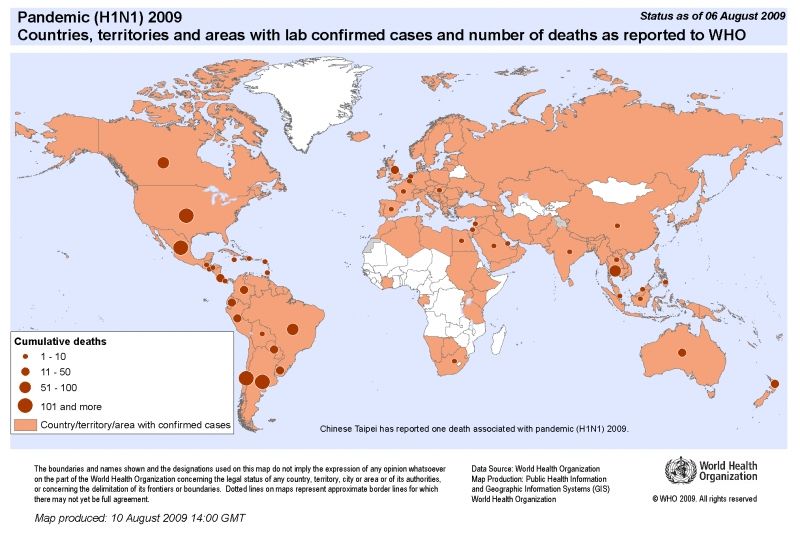
12.08.2009 - WHO
Stand 06.08.2009 werden offiziell 177.457 Fälle mit Influenza A(H1N1) Infektionen gemeldet, darunter 1.462 Todesfälle ... mehr mit Tabelle
-
Alexander
- Administrator
- Beiträge: 24253
- Registriert: Sa 30. Jul 2005, 19:12
- Wohnort: Dubai/Vereinigte Arabische Emirate
- Kontaktdaten:
Re: Schweinegrippe (Influenza A / H1N1)
Südliches Afrika bereitet sich auf Pandemie vor
Im Rennen gegen die Zeit bereiten sich die südlich der Sahara gelegenen afrikanischen Länder auf die erwartete Schweinegrippe-Pandemie vor. Wegen der grossen Risikogruppen könnten die Auswirkungen verheerend sein. mehr...
Grüsse
Alexander
Im Rennen gegen die Zeit bereiten sich die südlich der Sahara gelegenen afrikanischen Länder auf die erwartete Schweinegrippe-Pandemie vor. Wegen der grossen Risikogruppen könnten die Auswirkungen verheerend sein. mehr...
Grüsse
Alexander
The one who follows the crowd will usually go no further than the crowd. Those who walk alone are likely to find themselves in places no one has ever been before.
· · · Wüstenschiff-Veranstaltungsübersicht 2026 —> Alle Reise-Events auf einen Blick - Check it out !!!
· · · · · Werde Wüstenschiff-Werbepartner —> Firmen, die Wüstenschiff-Aktionen in Afrika unterstützen
· · · · · · · Geschlossene Gruppen —> Die neue Wüstenschiff-Funktion
· · · Wüstenschiff-Veranstaltungsübersicht 2026 —> Alle Reise-Events auf einen Blick - Check it out !!!
· · · · · Werde Wüstenschiff-Werbepartner —> Firmen, die Wüstenschiff-Aktionen in Afrika unterstützen
· · · · · · · Geschlossene Gruppen —> Die neue Wüstenschiff-Funktion
-
Birgitt
- Moderator
- Beiträge: 35244
- Registriert: Di 2. Aug 2005, 22:52
- Wohnort: NRW / Südl. Rheinland
- Kontaktdaten:
Re: Schweinegrippe (Influenza A / H1N1)
Pandemic (H1N1) 2009 - update 62
19.08.2009 - WHO
Stand 13.08.2009 werden offiziell 182.166 Fälle mit Influenza A(H1N1) Infektionen gemeldet,
darunter 1.799 Todesfälle ... mehr mit Tabelle + Karte
__________________________________
Schweinegrippe schränkt Muslime ein
19.08.2009 - Welt
Am Wochenende beginnt für Muslime der Ramadan. Wegen der Schweinegrippe gelten im Fastenmonat einige Einschränkungen. So sind Mekka-Reisen weniger gefragt. Die Veranstalter informieren die Pilger ausführlich, welche religiösen und hygienischen Vorschriften während Hadsch und Umrah einzuhalten sind ... mehr
Gruß
Birgitt
19.08.2009 - WHO
Stand 13.08.2009 werden offiziell 182.166 Fälle mit Influenza A(H1N1) Infektionen gemeldet,
darunter 1.799 Todesfälle ... mehr mit Tabelle + Karte
__________________________________
Schweinegrippe schränkt Muslime ein
19.08.2009 - Welt
Am Wochenende beginnt für Muslime der Ramadan. Wegen der Schweinegrippe gelten im Fastenmonat einige Einschränkungen. So sind Mekka-Reisen weniger gefragt. Die Veranstalter informieren die Pilger ausführlich, welche religiösen und hygienischen Vorschriften während Hadsch und Umrah einzuhalten sind ... mehr
Gruß
Birgitt
-
Birgitt
- Moderator
- Beiträge: 35244
- Registriert: Di 2. Aug 2005, 22:52
- Wohnort: NRW / Südl. Rheinland
- Kontaktdaten:
Re: Schweinegrippe (Influenza A / H1N1)
Recommended use of antivirals
Pandemic (H1N1) 2009 briefing note 8
21.08.2009 - WHO
GENEVA -- WHO is today issuing guidelines for the use of antivirals in the management of patients infected with the H1N1 pandemic virus.
The guidelines represent the consensus reached by an international panel of experts who reviewed all available studies on the safety and effectiveness of these drugs. Emphasis was placed on the use of oseltamivir and zanamivir to prevent severe illness and deaths, reduce the need for hospitalization, and reduce the duration of hospital stays.
The pandemic virus is currently susceptible to both of these drugs (known as neuraminidase inhibitors), but resistant to a second class of antivirals (the M2 inhibitors).
Worldwide, most patients infected with the pandemic virus continue to experience typical influenza symptoms and fully recover within a week, even without any form of medical treatment. Healthy patients with uncomplicated illness need not be treated with antivirals. On an individual patient basis, initial treatment decisions should be based on clinical assessment and knowledge about the presence of the virus in the community.
In areas where the virus is circulating widely in the community, clinicians seeing patients with influenza-like illness should assume that the pandemic virus is the cause. Treatment decisions should not wait for laboratory confirmation of H1N1 infection. This recommendation is supported by reports, from all outbreak sites, that the H1N1 virus rapidly becomes the dominant strain.
Treat serious cases immediately
Evidence reviewed by the panel indicates that oseltamivir, when properly prescribed, can significantly reduce the risk of pneumonia (a leading cause of death for both pandemic and seasonal influenza) and the need for hospitalization.
For patients who initially present with severe illness or whose condition begins to deteriorate, WHO recommends treatment with oseltamivir as soon as possible. Studies show that early treatment, preferably within 48 hours after symptom onset, is strongly associated with better clinical outcome. For patients with severe or deteriorating illness, treatment should be provided even if started later. Where oseltamivir is unavailable or cannot be used for any reason, zanamivir may be given.
This recommendation applies to all patient groups, including pregnant women, and all age groups, including young children and infants.
For patients with underlying medical conditions that increase the risk of more severe disease, WHO recommends treatment with either oseltamivir or zanamivir. These patients should also receive treatment as soon as possible after symptom onset, without waiting for the results of laboratory tests.
As pregnant women are included among groups at increased risk, WHO recommends that pregnant women receive antiviral treatment as soon as possible after symptom onset.
At the same time, the presence of underlying medical conditions will not reliably predict all or even most cases of severe illness. Worldwide, around 40% of severe cases are now occurring in previously healthy children and adults, usually under the age of 50 years. Some of these patients experience a sudden and very rapid deterioration in their clinical condition, usually on day 5 or 6 following the onset of symptoms.
Clinical deterioration is characterized by primary viral pneumonia, which destroys the lung tissue and does not respond to antibiotics, and the failure of multiple organs, including the heart, kidneys, and liver. These patients require management in intensive care units using therapies in addition to antivirals.
Clinicians, patients, and those providing home-based care need to be alert to warning signals that indicate progression to a more severe form of illness, and take urgent action, which should include treatment with oseltamivir. In cases of severe or deteriorating illness, clinicians may consider using higher doses of oseltamivir, and for a longer duration, than is normally prescribed.
Antiviral use in children
Following the recent publication of two clinical reviews, [1,2] some questions have been raised about the advisability of administering antivirals to children. The two clinical reviews used data that were considered by WHO and its expert panel when developing the current guidelines and are fully reflected in the recommendations.
WHO recommends prompt antiviral treatment for children with severe or deteriorating illness, and those at risk of more severe or complicated illness. This recommendation includes all children under the age of five years, as this age group is at increased risk of more severe illness. Otherwise healthy children, older than 5 years, need not be given antiviral treatment unless their illness persists or worsens.
Danger signs in all patients
Clinicians, patients, and those providing home-based care need to be alert to danger signs that can signal progression to more severe disease. As progression can be very rapid, medical attention should be sought when any of the following danger signs appear in a person with confirmed or suspected H1N1 infection:
________________________________
[1] Neuraminidase inhibitors for treatment and prophylaxis of influenza in children: systematic review and meta-analysis of randomised controlled trials. Shun-Shin M, Thompson M, Heneghan C et al. BMJ 2009;339:b3172; doi:10.1136/bmj.b3172
[2] Prescription of anti-influenza drugs for healthy adults: a systemic review and meta-analysis. Burch J, Stock C et al. Lancet Infect Dis 2009; doi:10.1016/S1473-3099(09)70199-9
Pandemic (H1N1) 2009 briefing note 8
21.08.2009 - WHO
GENEVA -- WHO is today issuing guidelines for the use of antivirals in the management of patients infected with the H1N1 pandemic virus.
The guidelines represent the consensus reached by an international panel of experts who reviewed all available studies on the safety and effectiveness of these drugs. Emphasis was placed on the use of oseltamivir and zanamivir to prevent severe illness and deaths, reduce the need for hospitalization, and reduce the duration of hospital stays.
The pandemic virus is currently susceptible to both of these drugs (known as neuraminidase inhibitors), but resistant to a second class of antivirals (the M2 inhibitors).
Worldwide, most patients infected with the pandemic virus continue to experience typical influenza symptoms and fully recover within a week, even without any form of medical treatment. Healthy patients with uncomplicated illness need not be treated with antivirals. On an individual patient basis, initial treatment decisions should be based on clinical assessment and knowledge about the presence of the virus in the community.
In areas where the virus is circulating widely in the community, clinicians seeing patients with influenza-like illness should assume that the pandemic virus is the cause. Treatment decisions should not wait for laboratory confirmation of H1N1 infection. This recommendation is supported by reports, from all outbreak sites, that the H1N1 virus rapidly becomes the dominant strain.
Treat serious cases immediately
Evidence reviewed by the panel indicates that oseltamivir, when properly prescribed, can significantly reduce the risk of pneumonia (a leading cause of death for both pandemic and seasonal influenza) and the need for hospitalization.
For patients who initially present with severe illness or whose condition begins to deteriorate, WHO recommends treatment with oseltamivir as soon as possible. Studies show that early treatment, preferably within 48 hours after symptom onset, is strongly associated with better clinical outcome. For patients with severe or deteriorating illness, treatment should be provided even if started later. Where oseltamivir is unavailable or cannot be used for any reason, zanamivir may be given.
This recommendation applies to all patient groups, including pregnant women, and all age groups, including young children and infants.
For patients with underlying medical conditions that increase the risk of more severe disease, WHO recommends treatment with either oseltamivir or zanamivir. These patients should also receive treatment as soon as possible after symptom onset, without waiting for the results of laboratory tests.
As pregnant women are included among groups at increased risk, WHO recommends that pregnant women receive antiviral treatment as soon as possible after symptom onset.
At the same time, the presence of underlying medical conditions will not reliably predict all or even most cases of severe illness. Worldwide, around 40% of severe cases are now occurring in previously healthy children and adults, usually under the age of 50 years. Some of these patients experience a sudden and very rapid deterioration in their clinical condition, usually on day 5 or 6 following the onset of symptoms.
Clinical deterioration is characterized by primary viral pneumonia, which destroys the lung tissue and does not respond to antibiotics, and the failure of multiple organs, including the heart, kidneys, and liver. These patients require management in intensive care units using therapies in addition to antivirals.
Clinicians, patients, and those providing home-based care need to be alert to warning signals that indicate progression to a more severe form of illness, and take urgent action, which should include treatment with oseltamivir. In cases of severe or deteriorating illness, clinicians may consider using higher doses of oseltamivir, and for a longer duration, than is normally prescribed.
Antiviral use in children
Following the recent publication of two clinical reviews, [1,2] some questions have been raised about the advisability of administering antivirals to children. The two clinical reviews used data that were considered by WHO and its expert panel when developing the current guidelines and are fully reflected in the recommendations.
WHO recommends prompt antiviral treatment for children with severe or deteriorating illness, and those at risk of more severe or complicated illness. This recommendation includes all children under the age of five years, as this age group is at increased risk of more severe illness. Otherwise healthy children, older than 5 years, need not be given antiviral treatment unless their illness persists or worsens.
Danger signs in all patients
Clinicians, patients, and those providing home-based care need to be alert to danger signs that can signal progression to more severe disease. As progression can be very rapid, medical attention should be sought when any of the following danger signs appear in a person with confirmed or suspected H1N1 infection:
- shortness of breath, either during physical activity or while resting
- difficulty in breathing
- turning blue
- bloody or coloured sputum
- chest pain
- altered mental status
- high fever that persists beyond 3 days
- low blood pressure.
________________________________
[1] Neuraminidase inhibitors for treatment and prophylaxis of influenza in children: systematic review and meta-analysis of randomised controlled trials. Shun-Shin M, Thompson M, Heneghan C et al. BMJ 2009;339:b3172; doi:10.1136/bmj.b3172
[2] Prescription of anti-influenza drugs for healthy adults: a systemic review and meta-analysis. Burch J, Stock C et al. Lancet Infect Dis 2009; doi:10.1016/S1473-3099(09)70199-9
-
Birgitt
- Moderator
- Beiträge: 35244
- Registriert: Di 2. Aug 2005, 22:52
- Wohnort: NRW / Südl. Rheinland
- Kontaktdaten:
Re: Schweinegrippe (Influenza A / H1N1)
Influenza A H1N1 ("Schweinegrippe") - Aktuelles
25.08.2009
Die Pandemie hat inzwischen mehr als 160 Länder erreicht. Es wurden mehr als 253.169 Infektionen labortechnisch bestätigt, darunter 2.572 Todesfälle (Stand 24. August 2009). Die Zahl der tatsächlich Infizierten dürfte deutlich höher sein. / Quelle: crm
Gruß
Birgitt
25.08.2009
Die Pandemie hat inzwischen mehr als 160 Länder erreicht. Es wurden mehr als 253.169 Infektionen labortechnisch bestätigt, darunter 2.572 Todesfälle (Stand 24. August 2009). Die Zahl der tatsächlich Infizierten dürfte deutlich höher sein. / Quelle: crm
Gruß
Birgitt
-
Birgitt
- Moderator
- Beiträge: 35244
- Registriert: Di 2. Aug 2005, 22:52
- Wohnort: NRW / Südl. Rheinland
- Kontaktdaten:
Re: Schweinegrippe (Influenza A / H1N1)
Preparing for the second wave: lessons from current outbreaks
Pandemic (H1N1) 2009 briefing note 9
28.08.2009 - WHO
GENEVA -- Monitoring of outbreaks from different parts of the world provides sufficient information to make some tentative conclusions about how the influenza pandemic might evolve in the coming months.
WHO is advising countries in the northern hemisphere to prepare for a second wave of pandemic spread. Countries with tropical climates, where the pandemic virus arrived later than elsewhere, also need to prepare for an increasing number of cases.
Countries in temperate parts of the southern hemisphere should remain vigilant. As experience has shown, localized “hot spots” of increasing transmission can continue to occur even when the pandemic has peaked at the national level.
H1N1 now the dominant virus strain
Evidence from multiple outbreak sites demonstrates that the H1N1 pandemic virus has rapidly established itself and is now the dominant influenza strain in most parts of the world. The pandemic will persist in the coming months as the virus continues to move through susceptible populations.
Close monitoring of viruses by a WHO network of laboratories shows that viruses from all outbreaks remain virtually identical. Studies have detected no signs that the virus has mutated to a more virulent or lethal form.
Likewise, the clinical picture of pandemic influenza is largely consistent across all countries. The overwhelming majority of patients continue to experience mild illness. Although the virus can cause very severe and fatal illness, also in young and healthy people, the number of such cases remains small.
Large populations susceptible to infection
While these trends are encouraging, large numbers of people in all countries remain susceptible to infection. Even if the current pattern of usually mild illness continues, the impact of the pandemic during the second wave could worsen as larger numbers of people become infected.
Larger numbers of severely ill patients requiring intensive care are likely to be the most urgent burden on health services, creating pressures that could overwhelm intensive care units and possibly disrupt the provision of care for other diseases.
Monitoring for drug resistance
At present, only a handful of pandemic viruses resistant to oseltamivir have been detected worldwide, despite the administration of many millions of treatment courses of antiviral drugs. All of these cases have been extensively investigated, and no instances of onward transmission of drug-resistant virus have been documented to date. Intense monitoring continues, also through the WHO network of laboratories.
Not the same as seasonal influenza
Current evidence points to some important differences between patterns of illness reported during the pandemic and those seen during seasonal epidemics of influenza.
The age groups affected by the pandemic are generally younger. This is true for those most frequently infected, and especially so for those experiencing severe or fatal illness.
To date, most severe cases and deaths have occurred in adults under the age of 50 years, with deaths in the elderly comparatively rare. This age distribution is in stark contrast with seasonal influenza, where around 90% of severe and fatal cases occur in people 65 years of age or older.
Severe respiratory failure
Perhaps most significantly, clinicians from around the world are reporting a very severe form of disease, also in young and otherwise healthy people, which is rarely seen during seasonal influenza infections. In these patients, the virus directly infects the lung, causing severe respiratory failure. Saving these lives depends on highly specialized and demanding care in intensive care units, usually with long and costly stays.
During the winter season in the southern hemisphere, several countries have viewed the need for intensive care as the greatest burden on health services. Some cities in these countries report that nearly 15 percent of hospitalized cases have required intensive care.
Preparedness measures need to anticipate this increased demand on intensive care units, which could be overwhelmed by a sudden surge in the number of severe cases.
Vulnerable groups
An increased risk during pregnancy is now consistently well-documented across countries. This risk takes on added significance for a virus, like this one, that preferentially infects younger people.
Data continue to show that certain medical conditions increase the risk of severe and fatal illness. These include respiratory disease, notably asthma, cardiovascular disease, diabetes and immunosuppression.
When anticipating the impact of the pandemic as more people become infected, health officials need to be aware that many of these predisposing conditions have become much more widespread in recent decades, thus increasing the pool of vulnerable people.
Obesity, which is frequently present in severe and fatal cases, is now a global epidemic. WHO estimates that, worldwide, more than 230 million people suffer from asthma, and more than 220 million people have diabetes.
Moreover, conditions such as asthma and diabetes are not usually considered killer diseases, especially in children and young adults. Young deaths from such conditions, precipitated by infection with the H1N1 virus, can be another dimension of the pandemic’s impact.
Higher risk of hospitalization and death
Several early studies show a higher risk of hospitalization and death among certain subgroups, including minority groups and indigenous populations. In some studies, the risk in these groups is four to five times higher than in the general population.
Although the reasons are not fully understood, possible explanations include lower standards of living and poor overall health status, including a high prevalence of conditions such as asthma, diabetes and hypertension.
Implications for the developing world
Such findings are likely to have growing relevance as the pandemic gains ground in the developing world, where many millions of people live under deprived conditions and have multiple health problems, with little access to basic health care.
As much current data about the pandemic come from wealthy and middle-income countries, the situation in developing countries will need to be very closely watched. The same virus that causes manageable disruption in affluent countries could have a devastating impact in many parts of the developing world.
Co-infection with HIV
The 2009 influenza pandemic is the first to occur since the emergence of HIV/AIDS. Early data from two countries suggest that people co-infected with H1N1 and HIV are not at increased risk of severe or fatal illness, provided these patients are receiving antiretroviral therapy. In most of these patients, illness caused by H1N1 has been mild, with full recovery.
If these preliminary findings are confirmed, this will be reassuring news for countries where infection with HIV is prevalent and treatment coverage with antiretroviral drugs is good.
On current estimates, around 33 million people are living with HIV/AIDS worldwide. Of these, WHO estimates that around 4 million were receiving antiretroviral therapy at the end of 2008.
Pandemic (H1N1) 2009 briefing note 9
28.08.2009 - WHO
GENEVA -- Monitoring of outbreaks from different parts of the world provides sufficient information to make some tentative conclusions about how the influenza pandemic might evolve in the coming months.
WHO is advising countries in the northern hemisphere to prepare for a second wave of pandemic spread. Countries with tropical climates, where the pandemic virus arrived later than elsewhere, also need to prepare for an increasing number of cases.
Countries in temperate parts of the southern hemisphere should remain vigilant. As experience has shown, localized “hot spots” of increasing transmission can continue to occur even when the pandemic has peaked at the national level.
H1N1 now the dominant virus strain
Evidence from multiple outbreak sites demonstrates that the H1N1 pandemic virus has rapidly established itself and is now the dominant influenza strain in most parts of the world. The pandemic will persist in the coming months as the virus continues to move through susceptible populations.
Close monitoring of viruses by a WHO network of laboratories shows that viruses from all outbreaks remain virtually identical. Studies have detected no signs that the virus has mutated to a more virulent or lethal form.
Likewise, the clinical picture of pandemic influenza is largely consistent across all countries. The overwhelming majority of patients continue to experience mild illness. Although the virus can cause very severe and fatal illness, also in young and healthy people, the number of such cases remains small.
Large populations susceptible to infection
While these trends are encouraging, large numbers of people in all countries remain susceptible to infection. Even if the current pattern of usually mild illness continues, the impact of the pandemic during the second wave could worsen as larger numbers of people become infected.
Larger numbers of severely ill patients requiring intensive care are likely to be the most urgent burden on health services, creating pressures that could overwhelm intensive care units and possibly disrupt the provision of care for other diseases.
Monitoring for drug resistance
At present, only a handful of pandemic viruses resistant to oseltamivir have been detected worldwide, despite the administration of many millions of treatment courses of antiviral drugs. All of these cases have been extensively investigated, and no instances of onward transmission of drug-resistant virus have been documented to date. Intense monitoring continues, also through the WHO network of laboratories.
Not the same as seasonal influenza
Current evidence points to some important differences between patterns of illness reported during the pandemic and those seen during seasonal epidemics of influenza.
The age groups affected by the pandemic are generally younger. This is true for those most frequently infected, and especially so for those experiencing severe or fatal illness.
To date, most severe cases and deaths have occurred in adults under the age of 50 years, with deaths in the elderly comparatively rare. This age distribution is in stark contrast with seasonal influenza, where around 90% of severe and fatal cases occur in people 65 years of age or older.
Severe respiratory failure
Perhaps most significantly, clinicians from around the world are reporting a very severe form of disease, also in young and otherwise healthy people, which is rarely seen during seasonal influenza infections. In these patients, the virus directly infects the lung, causing severe respiratory failure. Saving these lives depends on highly specialized and demanding care in intensive care units, usually with long and costly stays.
During the winter season in the southern hemisphere, several countries have viewed the need for intensive care as the greatest burden on health services. Some cities in these countries report that nearly 15 percent of hospitalized cases have required intensive care.
Preparedness measures need to anticipate this increased demand on intensive care units, which could be overwhelmed by a sudden surge in the number of severe cases.
Vulnerable groups
An increased risk during pregnancy is now consistently well-documented across countries. This risk takes on added significance for a virus, like this one, that preferentially infects younger people.
Data continue to show that certain medical conditions increase the risk of severe and fatal illness. These include respiratory disease, notably asthma, cardiovascular disease, diabetes and immunosuppression.
When anticipating the impact of the pandemic as more people become infected, health officials need to be aware that many of these predisposing conditions have become much more widespread in recent decades, thus increasing the pool of vulnerable people.
Obesity, which is frequently present in severe and fatal cases, is now a global epidemic. WHO estimates that, worldwide, more than 230 million people suffer from asthma, and more than 220 million people have diabetes.
Moreover, conditions such as asthma and diabetes are not usually considered killer diseases, especially in children and young adults. Young deaths from such conditions, precipitated by infection with the H1N1 virus, can be another dimension of the pandemic’s impact.
Higher risk of hospitalization and death
Several early studies show a higher risk of hospitalization and death among certain subgroups, including minority groups and indigenous populations. In some studies, the risk in these groups is four to five times higher than in the general population.
Although the reasons are not fully understood, possible explanations include lower standards of living and poor overall health status, including a high prevalence of conditions such as asthma, diabetes and hypertension.
Implications for the developing world
Such findings are likely to have growing relevance as the pandemic gains ground in the developing world, where many millions of people live under deprived conditions and have multiple health problems, with little access to basic health care.
As much current data about the pandemic come from wealthy and middle-income countries, the situation in developing countries will need to be very closely watched. The same virus that causes manageable disruption in affluent countries could have a devastating impact in many parts of the developing world.
Co-infection with HIV
The 2009 influenza pandemic is the first to occur since the emergence of HIV/AIDS. Early data from two countries suggest that people co-infected with H1N1 and HIV are not at increased risk of severe or fatal illness, provided these patients are receiving antiretroviral therapy. In most of these patients, illness caused by H1N1 has been mild, with full recovery.
If these preliminary findings are confirmed, this will be reassuring news for countries where infection with HIV is prevalent and treatment coverage with antiretroviral drugs is good.
On current estimates, around 33 million people are living with HIV/AIDS worldwide. Of these, WHO estimates that around 4 million were receiving antiretroviral therapy at the end of 2008.
-
Birgitt
- Moderator
- Beiträge: 35244
- Registriert: Di 2. Aug 2005, 22:52
- Wohnort: NRW / Südl. Rheinland
- Kontaktdaten:
Re: Schweinegrippe (Influenza A / H1N1)
Pandemic (H1N1) 2009 - update 63
Weekly update
28.08.2009 - WHO
In the southern hemisphere, most countries (represented by Chile, Argentina, New Zealand, and Australia) appear to have passed their peak of influenza activity and have either returned to baseline levels or are experiencing focal activity in later affect areas; while a few others (represented by South Africa and Bolivia) continue to experience high levels of influenza activity.
Many countries in tropical regions (represented by Central America and tropical regions of Asia), continue to see increasing or sustained high levels of influenza activity with some countries reporting moderate strains on the healthcare system. In temperate areas of the northern hemisphere (represented by North America, Europe, and Central Asia), influenza and respiratory disease activity remains low overall, with some countries experiencing localized outbreaks. In Japan, the level of influenza activity has passed the seasonal epidemic threshold, signaling a very early beginning to the annual influenza season.
Pandemic H1N1 influenza virus continues to be the predominant circulating strain of influenza, both in the northern and southern hemisphere. Antiviral susceptibility testing has increased in several countries, confirming that pandemic H1N1 influenza virus remains sensitive to the antiviral oseltamivir, except for sporadic reports of oseltamivir resistant pandemic H1N1 virus detailed in the previous web update (No. 62) ... mehr

Weekly update
28.08.2009 - WHO
In the southern hemisphere, most countries (represented by Chile, Argentina, New Zealand, and Australia) appear to have passed their peak of influenza activity and have either returned to baseline levels or are experiencing focal activity in later affect areas; while a few others (represented by South Africa and Bolivia) continue to experience high levels of influenza activity.
Many countries in tropical regions (represented by Central America and tropical regions of Asia), continue to see increasing or sustained high levels of influenza activity with some countries reporting moderate strains on the healthcare system. In temperate areas of the northern hemisphere (represented by North America, Europe, and Central Asia), influenza and respiratory disease activity remains low overall, with some countries experiencing localized outbreaks. In Japan, the level of influenza activity has passed the seasonal epidemic threshold, signaling a very early beginning to the annual influenza season.
Pandemic H1N1 influenza virus continues to be the predominant circulating strain of influenza, both in the northern and southern hemisphere. Antiviral susceptibility testing has increased in several countries, confirming that pandemic H1N1 influenza virus remains sensitive to the antiviral oseltamivir, except for sporadic reports of oseltamivir resistant pandemic H1N1 virus detailed in the previous web update (No. 62) ... mehr
-
Alexander
- Administrator
- Beiträge: 24253
- Registriert: Sa 30. Jul 2005, 19:12
- Wohnort: Dubai/Vereinigte Arabische Emirate
- Kontaktdaten:
Re: Schweinegrippe (Influenza A / H1N1)
Minister sollen bevorzugt gegen Schweinegrippe geimpft werden 
Die Bundesregierung hat erstmals eingeräumt, dass Minister und Staatssekretäre bei der geplanten Schweinegrippe-Impfung im Herbst mit als erste geimpft werden sollen. Das berichtet die «Bild»-Zeitung (Mittwochausgabe) unter Berufung auf eine Antwort des Bundesgesundheitsministeriums auf eine Anfrage im Bundestag. Die Regierungsmitglieder sollen nach Angaben des Parlamentarischen Staatssekretärs im Gesundheitsministerium, Rolf Schwanitz (SPD), zusammen mit dem «Schlüsselpersonal» des Bundes vorrangig geimpft werden. mehr...
Grüsse
Alexander
Die Bundesregierung hat erstmals eingeräumt, dass Minister und Staatssekretäre bei der geplanten Schweinegrippe-Impfung im Herbst mit als erste geimpft werden sollen. Das berichtet die «Bild»-Zeitung (Mittwochausgabe) unter Berufung auf eine Antwort des Bundesgesundheitsministeriums auf eine Anfrage im Bundestag. Die Regierungsmitglieder sollen nach Angaben des Parlamentarischen Staatssekretärs im Gesundheitsministerium, Rolf Schwanitz (SPD), zusammen mit dem «Schlüsselpersonal» des Bundes vorrangig geimpft werden. mehr...
Grüsse
Alexander
The one who follows the crowd will usually go no further than the crowd. Those who walk alone are likely to find themselves in places no one has ever been before.
· · · Wüstenschiff-Veranstaltungsübersicht 2026 —> Alle Reise-Events auf einen Blick - Check it out !!!
· · · · · Werde Wüstenschiff-Werbepartner —> Firmen, die Wüstenschiff-Aktionen in Afrika unterstützen
· · · · · · · Geschlossene Gruppen —> Die neue Wüstenschiff-Funktion
· · · Wüstenschiff-Veranstaltungsübersicht 2026 —> Alle Reise-Events auf einen Blick - Check it out !!!
· · · · · Werde Wüstenschiff-Werbepartner —> Firmen, die Wüstenschiff-Aktionen in Afrika unterstützen
· · · · · · · Geschlossene Gruppen —> Die neue Wüstenschiff-Funktion
-
Birgitt
- Moderator
- Beiträge: 35244
- Registriert: Di 2. Aug 2005, 22:52
- Wohnort: NRW / Südl. Rheinland
- Kontaktdaten:
Re: Schweinegrippe (Influenza A / H1N1)
Denn sie wissen nicht, was sie tun ...Alexander hat geschrieben:Minister sollen bevorzugt gegen Schweinegrippe geimpft werden
Nebenwirkungen der Impfung sind auf unten stehendem Foto ersichtlich.
Über die Dauer der Hautveränderungen liegen noch keine Studien vor.

Quelle: unbekannt
Gruß

Birgitt
-
Birgitt
- Moderator
- Beiträge: 35244
- Registriert: Di 2. Aug 2005, 22:52
- Wohnort: NRW / Südl. Rheinland
- Kontaktdaten:
Re: Schweinegrippe (Influenza A / H1N1)
Pandemic (H1N1) 2009 - update 64
Weekly update
04.09.2009 - WHO
Tropical regions of South and Southeast Asia continue to experience geographically regional or widespread influenza activity (represented by countries such as India, Bangladesh, Myanmar, Thailand, Cambodia, Sri Lanka, and Indonesia). Many countries in the region are reporting increasing or sustained high levels of respiratory disease, and a few (Thailand and Brunei Darussalam) have begun to report a declining trend in the level of respiratory diseases.
In tropical regions of Central America and the Caribbean (represented by countries such as Costa Rica, El Salvador, Guatemala, Honduras, Panama, and Cuba), influenza activity continues to be geographically regional or widespread, however, most are now reporting a declining trend in the level of respiratory diseases.
Countries in the equatorial and tropical regions of South America (represented by Ecuador, Venzezuela, Peru, and parts of Brazil) continue to experience geographically regional or widespread influenza activity, with many reporting an increasing trend in the level of respiratory diseases.
Although many countries in temperate regions of the southern hemisphere (Chile, Argentina, Australia, and New Zealand) have passed the peak of their winter influenza epidemic, sustained influenza activity continues to be reported in South Africa and in the Southern and Western parts of Australia.
In temperate regions of the northern hemisphere, there are wide geographical variations in the level of influenza activity being reported. In Japan, influenza activity continues to increase past the seasonal epidemic threshold, indicating an early beginning to the to annual influenza season. In Canada and the United States, influenza activity remain low overall, however regional increases are being detected in the Southeastern United States. In Europe and Central and Western Asia, although little influenza activity is being reported, a few countries are reporting geographically widespread influenza activity (Austria and Israel) or an increasing trend in respiratory diseases (Netherlands and Romania).
Pandemic (H1N1) influenza virus continues to be the predominant circulating virus of influenza, both in the northern and southern hemisphere. All pandemic H1N1 2009 influenza viruses analysed to date have been antigenically and genetically similar to A/California/7/2009-like pandemic H1N1 2009 virus. See below for detailed laboratory surveillance update ... mehr
Gruß
Birgitt
Weekly update
04.09.2009 - WHO
Tropical regions of South and Southeast Asia continue to experience geographically regional or widespread influenza activity (represented by countries such as India, Bangladesh, Myanmar, Thailand, Cambodia, Sri Lanka, and Indonesia). Many countries in the region are reporting increasing or sustained high levels of respiratory disease, and a few (Thailand and Brunei Darussalam) have begun to report a declining trend in the level of respiratory diseases.
In tropical regions of Central America and the Caribbean (represented by countries such as Costa Rica, El Salvador, Guatemala, Honduras, Panama, and Cuba), influenza activity continues to be geographically regional or widespread, however, most are now reporting a declining trend in the level of respiratory diseases.
Countries in the equatorial and tropical regions of South America (represented by Ecuador, Venzezuela, Peru, and parts of Brazil) continue to experience geographically regional or widespread influenza activity, with many reporting an increasing trend in the level of respiratory diseases.
Although many countries in temperate regions of the southern hemisphere (Chile, Argentina, Australia, and New Zealand) have passed the peak of their winter influenza epidemic, sustained influenza activity continues to be reported in South Africa and in the Southern and Western parts of Australia.
In temperate regions of the northern hemisphere, there are wide geographical variations in the level of influenza activity being reported. In Japan, influenza activity continues to increase past the seasonal epidemic threshold, indicating an early beginning to the to annual influenza season. In Canada and the United States, influenza activity remain low overall, however regional increases are being detected in the Southeastern United States. In Europe and Central and Western Asia, although little influenza activity is being reported, a few countries are reporting geographically widespread influenza activity (Austria and Israel) or an increasing trend in respiratory diseases (Netherlands and Romania).
Pandemic (H1N1) influenza virus continues to be the predominant circulating virus of influenza, both in the northern and southern hemisphere. All pandemic H1N1 2009 influenza viruses analysed to date have been antigenically and genetically similar to A/California/7/2009-like pandemic H1N1 2009 virus. See below for detailed laboratory surveillance update ... mehr
Gruß
Birgitt
-
Birgitt
- Moderator
- Beiträge: 35244
- Registriert: Di 2. Aug 2005, 22:52
- Wohnort: NRW / Südl. Rheinland
- Kontaktdaten:
Re: Schweinegrippe (Influenza A / H1N1)
Pandemic (H1N1) 2009 - update 65
Weekly update
11.09.2009 - WHO
In the temperate region of the southern hemisphere (represented by countries such as Chile, Argentina, Australia, New Zealand, and South Africa), influenza activity continues to decrease or return to baseline.
Active transmission persists in tropical regions of the Americas and Asia. Many countries in Central America and the Caribbean continue to report declining activity for the second week in a row. However, countries in the tropical region of South America (represented by countries such as Bolivia, Ecuador, and Venezuela) are reporting increasing levels of respiratory disease. In the tropical regions of Asia, respiratory disease activity remains geographically regional or widespread but the trend is generally increasing as noted in India, Bangladesh, and Cambodia.
In the temperate regions of the Northern Hemisphere activity is variable. In the United States, regional increases in influenza activity are being reported, most notably in the south eastern states. Most of Europe is reporting low or moderate respiratory diseases activity, but parts of Eastern Europe are beginning to report increases in activity.
WHO Collaborating Centres and other laboratories continue to report sporadic isolates of oseltamivir resistant influenza virus. 21 such virus isolates have now been described from around the world, all of which carry the same H275Y mutation that confers resistance to the antiviral oseltamivir but not to the antiviral zanamivir. Of these, 12 have been associated with post-exposure prophylaxis, four with long term oseltamivir treatment in patients with immunosuppression. Worldwide, over 10,000 isolates of the pandemic (H1N1) 2009 virus have been tested and found to be sensitive to oseltamivir. WHO will continue to monitor the situation closely in collaboration with its partners, but is not changing its guidelines for use of antiviral drugs at this time.
Pandemic (H1N1) influenza virus continues to be the predominant circulating virus of influenza, both in the northern and southern hemisphere. All pandemic H1N1 2009 influenza viruses analysed to date have been antigenically and genetically similar to A/California/7/2009-like pandemic H1N1 2009 virus. See below for detailed laboratory surveillance update.
Of note, the U.S. Centers for Disease Control and Prevention this week reported on an analysis of 36 fatal pandemic influenza cases in children under the age of 18 years. Sixty-seven percent of the children had one or more high-risk medical conditions, most commonly neurodevelopmental disorders. In addition, ten of 23 children for whom data were available were found to have strong evidence of secondary bacterial co-infections ... mehr
Gruß
Birgitt
Weekly update
11.09.2009 - WHO
In the temperate region of the southern hemisphere (represented by countries such as Chile, Argentina, Australia, New Zealand, and South Africa), influenza activity continues to decrease or return to baseline.
Active transmission persists in tropical regions of the Americas and Asia. Many countries in Central America and the Caribbean continue to report declining activity for the second week in a row. However, countries in the tropical region of South America (represented by countries such as Bolivia, Ecuador, and Venezuela) are reporting increasing levels of respiratory disease. In the tropical regions of Asia, respiratory disease activity remains geographically regional or widespread but the trend is generally increasing as noted in India, Bangladesh, and Cambodia.
In the temperate regions of the Northern Hemisphere activity is variable. In the United States, regional increases in influenza activity are being reported, most notably in the south eastern states. Most of Europe is reporting low or moderate respiratory diseases activity, but parts of Eastern Europe are beginning to report increases in activity.
WHO Collaborating Centres and other laboratories continue to report sporadic isolates of oseltamivir resistant influenza virus. 21 such virus isolates have now been described from around the world, all of which carry the same H275Y mutation that confers resistance to the antiviral oseltamivir but not to the antiviral zanamivir. Of these, 12 have been associated with post-exposure prophylaxis, four with long term oseltamivir treatment in patients with immunosuppression. Worldwide, over 10,000 isolates of the pandemic (H1N1) 2009 virus have been tested and found to be sensitive to oseltamivir. WHO will continue to monitor the situation closely in collaboration with its partners, but is not changing its guidelines for use of antiviral drugs at this time.
Pandemic (H1N1) influenza virus continues to be the predominant circulating virus of influenza, both in the northern and southern hemisphere. All pandemic H1N1 2009 influenza viruses analysed to date have been antigenically and genetically similar to A/California/7/2009-like pandemic H1N1 2009 virus. See below for detailed laboratory surveillance update.
Of note, the U.S. Centers for Disease Control and Prevention this week reported on an analysis of 36 fatal pandemic influenza cases in children under the age of 18 years. Sixty-seven percent of the children had one or more high-risk medical conditions, most commonly neurodevelopmental disorders. In addition, ten of 23 children for whom data were available were found to have strong evidence of secondary bacterial co-infections ... mehr
Gruß
Birgitt
-
Birgitt
- Moderator
- Beiträge: 35244
- Registriert: Di 2. Aug 2005, 22:52
- Wohnort: NRW / Südl. Rheinland
- Kontaktdaten:
Re: Schweinegrippe (Influenza A / H1N1)
Influenza A H1N1 ("Schweinegrippe") - Aktuelles
14.09.2009
Die Pandemie hat inzwischen mehr als 160 Länder erreicht. Es wurden mehr als 277.607 Infektionen labortechnisch bestätigt, darunter 3.205 Todesfälle (Stand 6. September 2009). Die Zahl der tatsächlich Infizierten dürfte deutlich höher sein. / Quelle: crm
Gruß
Birgitt
14.09.2009
Die Pandemie hat inzwischen mehr als 160 Länder erreicht. Es wurden mehr als 277.607 Infektionen labortechnisch bestätigt, darunter 3.205 Todesfälle (Stand 6. September 2009). Die Zahl der tatsächlich Infizierten dürfte deutlich höher sein. / Quelle: crm
Gruß
Birgitt
-
Birgitt
- Moderator
- Beiträge: 35244
- Registriert: Di 2. Aug 2005, 22:52
- Wohnort: NRW / Südl. Rheinland
- Kontaktdaten:
Re: Schweinegrippe (Influenza A / H1N1)
Pandemic (H1N1) 2009 - update 66
Weekly update
18.09.2009 - WHO
In the temperate regions* of the northern hemisphere, influenza activity remains widely variable. In North America, the United States is reporting increases in influenza-like-illness activity above the seasonal baseline, most notably in the southern, southeastern, and parts of the northeastern United States.
In Canada, influenza activity remains low. In Europe and Central Asia influenza activity remains low overall, except in France, which is reporting increases in influenza-like-illness activity (for week 37) above the seasonal epidemic threshold. Geographically localized influenza activity is being reported in several countries (Austria, Georgia, Ireland, Luxembourg, Norway, Portugal, the Czech Republic, Cyprus, and Israel). In Japan, influenza activity remains stably increased above the seasonal epidemic threshold with the most notable increases being reported on the southern island of Okinawa.
In the tropical regions of the Americas and Asia, influenza transmission remains active. Geographically regional to widespread influenza activity continues to be reported throughout much of South and Southeast Asia, with increasing trends in respiratory diseases being reported in India and Bangladesh. Geographically regional to widespread influenza activity continues to be reported for the tropical regions of Central and South America without a consistent pattern in the trend of respiratory diseases (continued increases are being reported in Bolivia and Venezuela).
In the temperate regions* of the southern hemisphere, influenza activity continues to decrease or has returned to the seasonal baseline in most countries. In Australia, later affected areas are also now reporting declining levels of influenza-like-illness. In South Africa, influenza activity appears to have recently passed over the second peak (the first peak was due to seasonal influenza A (H3N2) and second peak was due to pandemic (H1N1) 2009).
WHO Collaborating Centres and other laboratories continue to report sporadic isolates of oseltamivir resistant influenza virus. Twenty six such virus isolates have now been described from around the world, all of which carry the same H275Y mutation that confers resistance to the antiviral oseltamivir but not to the antiviral zanamivir. Of these, 12 have been associated with post-exposure prophylaxis, five with long term oseltamivir treatment in patients with immunosuppression. Worldwide, over 10,000 clinical samples and isolates of the pandemic (H1N1) 2009 virus have been tested and found to be sensitive to oseltamivir. WHO will continue to monitor the situation closely in collaboration with its partners.
Pandemic (H1N1) influenza virus continues to be the predominant circulating influenza virus, both in the northern and southern hemisphere. See below for detailed laboratory surveillance update.
*Countries in temperate regions are defined as those north of the Tropic of Cancer or south of the Tropic of Capricorn, while countries in tropical regions are defined as those between these two latitudes ... mehr
Gruß
Birgitt
Weekly update
18.09.2009 - WHO
In the temperate regions* of the northern hemisphere, influenza activity remains widely variable. In North America, the United States is reporting increases in influenza-like-illness activity above the seasonal baseline, most notably in the southern, southeastern, and parts of the northeastern United States.
In Canada, influenza activity remains low. In Europe and Central Asia influenza activity remains low overall, except in France, which is reporting increases in influenza-like-illness activity (for week 37) above the seasonal epidemic threshold. Geographically localized influenza activity is being reported in several countries (Austria, Georgia, Ireland, Luxembourg, Norway, Portugal, the Czech Republic, Cyprus, and Israel). In Japan, influenza activity remains stably increased above the seasonal epidemic threshold with the most notable increases being reported on the southern island of Okinawa.
In the tropical regions of the Americas and Asia, influenza transmission remains active. Geographically regional to widespread influenza activity continues to be reported throughout much of South and Southeast Asia, with increasing trends in respiratory diseases being reported in India and Bangladesh. Geographically regional to widespread influenza activity continues to be reported for the tropical regions of Central and South America without a consistent pattern in the trend of respiratory diseases (continued increases are being reported in Bolivia and Venezuela).
In the temperate regions* of the southern hemisphere, influenza activity continues to decrease or has returned to the seasonal baseline in most countries. In Australia, later affected areas are also now reporting declining levels of influenza-like-illness. In South Africa, influenza activity appears to have recently passed over the second peak (the first peak was due to seasonal influenza A (H3N2) and second peak was due to pandemic (H1N1) 2009).
WHO Collaborating Centres and other laboratories continue to report sporadic isolates of oseltamivir resistant influenza virus. Twenty six such virus isolates have now been described from around the world, all of which carry the same H275Y mutation that confers resistance to the antiviral oseltamivir but not to the antiviral zanamivir. Of these, 12 have been associated with post-exposure prophylaxis, five with long term oseltamivir treatment in patients with immunosuppression. Worldwide, over 10,000 clinical samples and isolates of the pandemic (H1N1) 2009 virus have been tested and found to be sensitive to oseltamivir. WHO will continue to monitor the situation closely in collaboration with its partners.
Pandemic (H1N1) influenza virus continues to be the predominant circulating influenza virus, both in the northern and southern hemisphere. See below for detailed laboratory surveillance update.
*Countries in temperate regions are defined as those north of the Tropic of Cancer or south of the Tropic of Capricorn, while countries in tropical regions are defined as those between these two latitudes ... mehr
Gruß
Birgitt