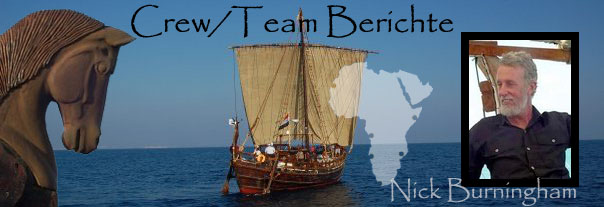
Hi members/ guests of wuestenschiff,
Turning now to Phoenicia.
I am not the primary designer of the Phoenicia.
The main source of evidence about Phoenician ship-design from approximately 6th century BCE is shipwrecks off the Mediterranean coast of France: the so-called Jules-Verne wrecks, particularly the wrecks designated J-V 7 and 9.
The designs of those wrecks were reconstructed by Professor Patrice Pomey and colleagues. There are other Phoenician wrecks off the coast of Spain and elsewhere.
Phillip Beales wish was for a ship considerably larger than any Phoenician ship known from shipwreck archaeology. He also wanted a fully-decked ship with a modern cabin and accommodation.
Kostas Damianidis made drawings of a design based on the J-V wrecks, scaled up and modified to Phillips specifications. I only modified Damianidis' drawings where they were impractical and where the various drawings did not agree with each other.
Aside from that, my role was to interpret the design to the master shipwright, Khalid, on Arwad, and at the start of the construction I explained plank-first construction with the planks joined edge-to-edge using tenons.
Normal boatbuilding on Arwad is frame-first construction. Some details of the ancient Phoenician construction seemingly remained unchanged on Arwad, particularly the rabbet or rebate on the stem and stenpost (stevenen) and the sudden transition to a bevel with no rebate about 1m from either end of the keel.
Khalid and his team adapted to plank-first construction remarkably well. The main difficulty was acquiring big pieces of naturally shaped timber and acquiring an adequately big mast. The mast on Phoenicia is not of adequate diameter towards the top in my opinion. I did the sail-making and set up the rigging when the ship was ready.
The other big problem has been the system for securing the rudders. The beam to which they are secured was not big enough and did not protrude far enough (though it was bigger than specified by Damianidis). We do not know how the rudders of Phoenician ships were secured. The Borobudur ship had similar rudders mounted on the quarters.
Indonesians continue to use such rudders until know, so the expertise is still available. However, the very limited iconography does not obviously show a system like the Indonesia rudder mounting system in the ancient Mediterranean.
As you will know, Phoenicia's rudders came away from their mounting whenever the ship sailed at a reasonable speed. The problem was not resolved until some Indonesian seamen from the Borobudur ship joined the expedition and built an Indonesian rudder mounting.
You ask about Phillip's motivation and financial situation. I think Phillip is driven by a kind of obsession (you could say the same about me). He does not often seem to enjoy these projects. He is not extremely wealthy, as far as I know. He used to be a superannuation fund manager. He uses his own finances to start his projects and also looks for sponsors to share the financial burden. You can see the sponsors on the websites.
And you ask also about "rebirth of history".
"Living history" and "experimental archaeology" are other names used to describe this kind of recreation of aspects of the past for serious academic reasons. It's a subject I sometimes write and speak about. Indeed I will speaking about it at a conference in Beijing, China next week.
One of the basic principles, in my opinion, is that experimental archaeology using replica or reconstruction sailing vessels is too expensive for most museums and universities to indulge in.
Fortunately, replica ship projects are initiated for other reasons. The challenge and opportunity is for archaeology to be involved in ways that make replica projects authentic, good research, but do not contradict the other aims of a project.
Personally I have been involved in replica ship projects because i have been obsessively interested in traditional sailing ships and how they were sailed since I was a child. I don't know why.
It is not a good career path, but it is very interesting to me.
When a replica ship performs well, it is satisfying. The Duyfken replica and the Borobudur ship have both performed well.
Enough for today I think.
Nick Burningham
(Übersetzung folgt gleich)